
Event Report: Higher Education in Syria’s Transformation Process
How can higher education contribute to Syria’s reconstruction? What opportunities do German-Syrian university partnerships offer, and what role does the academic diaspora play? These questions were at the heart of a higher education dialogue organised on 3 November 2026 by the BMZ's ‘A New Beginning for Syria’ platform, together with Humboldt-Universität zu Berlin (HU), the Berlin Institute for Integration and Migration Research (BIM), German Jordanian University (GJU) and the German Academic Exchange Service (DAAD).
Around 100 participants from academia, politics and civil society, including numerous representatives of the Syrian academic diaspora, discussed the challenges and prospects for the future of Syria’s higher education system. The Syrian government was also represented by Prof. Dr. Abdul Hamid Al-Khaled, Deputy Minister of Higher Education and Scientific Research.
Resuming and Expanding University Partnerships
The first part of the event focused on the current needs of Syria’s higher education system and concrete opportunities for academic cooperation.
Dr Yoan Villain (HU) and Prof. Dr Naika Foroutan (HU/BIM) emphasised the importance of renewed academic exchange and the strong interest among Syrian universities in international cooperation. Prof. Dr Ralf Rosskopf, Vice President of GJU, presented findings from a fact-finding mission conducted as part of a DAAD-funded project. One key finding was that Syrian universities continue to have academic expertise and institutional structures in place, but operate under severely constrained conditions. The most pressing needs include securing staff and funding, strengthening research capacities, improving digital learning infrastructure and expanding practice-oriented education.
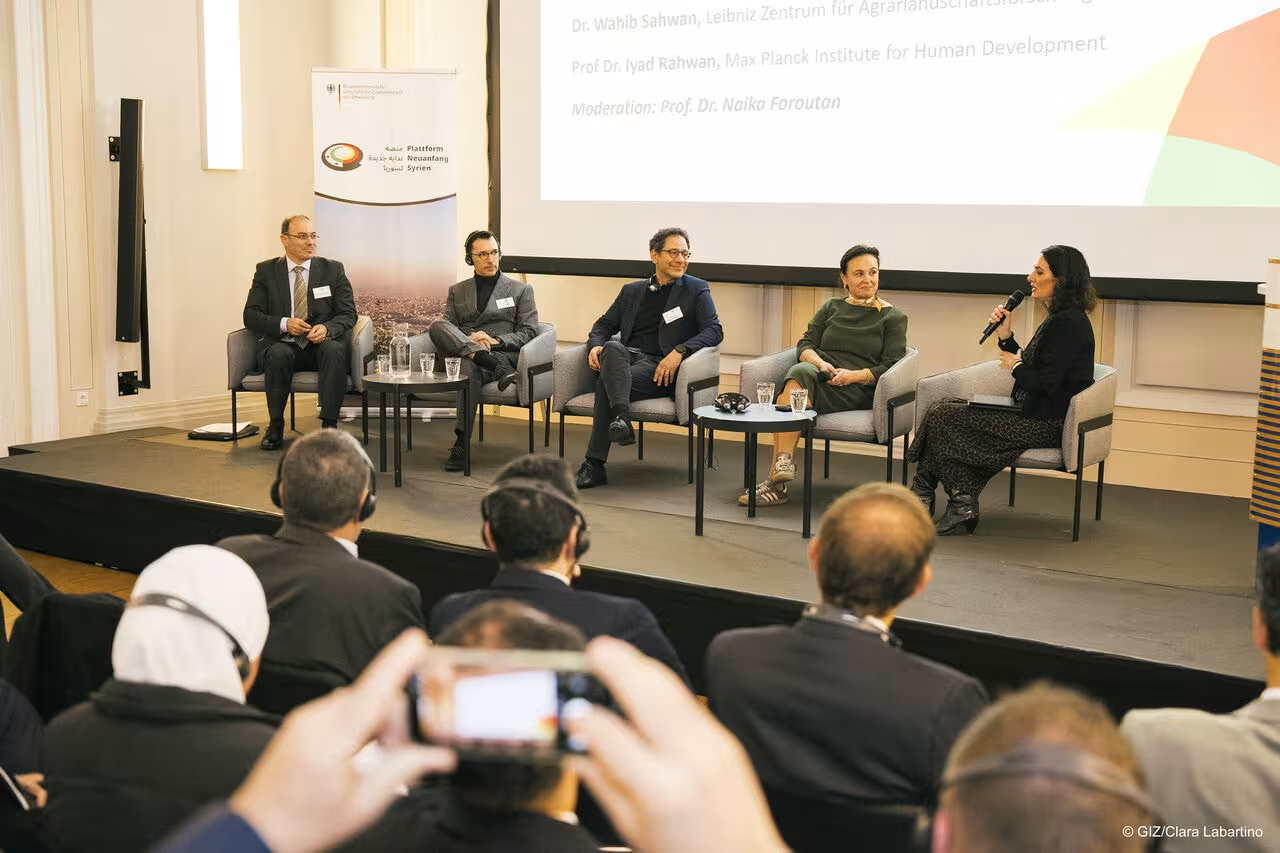
The subsequent expert contributions highlighted the wide range of opportunities for German-Syrian academic cooperation. Prof. Dr Malek Bajbouj (Charité) reported on German-Syrian hospital partnerships in the fields of mental health and trauma management. Dr Wahib Sahwan (Leibniz Centre for Agricultural Landscape Research) presented initiatives to foster academic networking and the exchange of research data. Prof. Dr Iyad Rahwan (Max Planck Institute for Human Development) highlighted the potential of digital technologies and artificial intelligence. Ayse Asar, Member of the German Bundestag, particularly emphasised the expertise of the Syrian medical diaspora in Germany.
The discussions made clear that, alongside financial resources and infrastructure, long-term partnerships and knowledge exchange are particularly important for rebuilding the higher education system. The audience discussion also raised questions concerning trust, inclusion and the participation of Kurdish academics.
Higher Education Reforms, Participation and the Role of the Diaspora
The second part of the event focused on the political and institutional framework conditions for higher education in Syria. In their welcoming remarks, Annette Chammas (BMZ), Michael Harms (DAAD) and Prof. Dr Ralf Rosskopf (GJU) emphasised the importance of international cooperation in education and higher education, as well as the special role of the Syrian academic diaspora in building bridges between Germany and Syria.
In a discussion moderated by journalist Asia Haidar, Syrian Deputy Minister of Higher Education Prof. Dr Abdul Hamid Al-Khaled outlined his ministry’s reform priorities. These include modernising higher education infrastructure, revising curricula, digitalisation, the recognition of academic qualifications and aligning higher education more closely with labour market needs. He also stressed the importance of international cooperation and the involvement of Syrian academics abroad. Moderator Asia Haidar also addressed sensitive issues such as academic freedom, gender-based admission restrictions and the integration of universities established during the war. In response, the Deputy Minister explained his ministry’s positions and, regarding admission restrictions for certain degree programmes, referred to ongoing discussions with the relevant bodies and committees.
The subsequent panel discussion with Anke Reiffenstuel (Federal Foreign Office), Prof. Dr Hani Harb (German-Syrian Research Foundation) and Prof. Dr Abdul Hamid Al-Khaled focused in particular on the recognition of foreign academic qualifications, joint research projects and opportunities for visiting scholars. It was emphasised that the involvement of the diaspora must be based on mutual exchange and cooperation on an equal footing, taking into account the experiences of academics who have remained in Syria.
The audience discussion raised further questions, particularly regarding the future of Kurdish universities and their international partnerships. The Deputy Minister explained his ministry’s position on the future integration of these universities into the Syrian higher education system. He emphasised that existing international partnerships should be maintained.
Kurzinterview mit Prof. Dr. Hani Harb
Kurzinterview mit Hilal Abdulrazak
Kurzinterview mit Omar Alkadamani
Dialogue and Cooperation as the Foundation for the Future
The higher education dialogue highlighted the strong interest in deepening German-Syrian university cooperation, as well as the political and institutional challenges of the transformation process. In her closing remarks, HU President Prof. Dr Julia von Blumenthal emphasised the importance of sustainable prospects for academic research and international partnerships based on mutual respect and cooperation on an equal footing.
The event provided space for expert exchange, personal networking and open discussion of different perspectives. It thus demonstrated the added value of ‘A New Beginning for Syria’ platform as a space for dialogue, exchange and networking among different stakeholders.
Downloads
Photos
Download the File Transfer here!
Transfer ID: LsRnnVXqo0
Password: NeuanfangSyrien0311
Available until: 1 December
Here you will find a selection of photos taken during the event. You are welcome to download and use them for your own communications and outreach activities. If you share any of the photos on LinkedIn, we would appreciate it if you tagged the Platform’s LinkedIn profile and credited the photos as GIZ/Clara Labartino.
Slides
-
Präsentation zu DAAD SyrIA: Aktuelle Bedarfe syrischer Hochschulen vom 03.11.2026727.87 KB
The ‘A New Beginning for Syria’ platform is planning further information and networking events in the near future. You can receive further information about upcoming events organised as part of the ‘A New Beginning for Syria’ platform via our email distribution list and our LinkedIn group, which we warmly invite you to join.
Do you have any ideas or questions you would like to share with us about the ‘A New Beginning for Syria’ platform? Would you like to contribute your experience and expertise? Get in touch with us.


